<?xml version="1.0" encoding="utf-8"?>
<feed xmlns="http://www.w3.org/2005/Atom" xml:lang="en">

    <title type="text">Culture Making Articles items tagged food and drink</title>
    <subtitle type="text">Culture Making Articles:Writing on Christianity and culture from Andy Crouch</subtitle>
    <link rel="alternate" type="text/html" href="http://culture-makers.com/" />
    <link rel="self" type="application/atom+xml" href="https://culture-making.com/tag/atom" />
    <updated>2025-01-03T22:54:05Z</updated>
    <rights>Copyright (c) 2025, Andy Crouch</rights>
    <generator uri="http://www.pmachine.com/" version="7.5.15">ExpressionEngine</generator>
    <id>tag:culture-makers.com,2025:01:02</id>

    <entry>
      <title>Dinner with strangers</title>
      <link rel="alternate" type="text/html" href="https://culture-making.com/post/dinner_with_strangers" />
      <id>tag:culture-makers.com,2025:author/1.2024</id>
      <published>2025-01-02T22:53:00Z</published>
      <updated>2025-01-03T22:54:05Z</updated>
      <author>
            <name>Andy Crouch</name>
            <email>andy@culture-making.com</email>
            
      </author>

      <content type="html"><![CDATA[


					<b>Nate: </b><em>?The author of <em>How Proust Can Change Your Life</em> discovers that religion can too.?</em><br />
		
		<p>Religions, he thinks, have the buttons and know how to use them. His book considers the Catholic mass, early Christianitiy&#8217;s ritual of agape or love feasts, and Jewish Passover rituals to explore how religions encouraged us to overcome fear of strangers and create communities. He then tentatively imagines a so-called &#8220;agape restaurant&#8221; where, instead of dining with like-minded friends, you would be invited to eat with strangers. It would be the antithesis of Facebook.</p><hr />
<div class="author" style="font-size: -1">from "<a href="http://www.guardian.co.uk/culture/2012/jan/20/alain-de-botton-life-in-writing">Alain de Botton: a life in writing</a>," by Stuart Jeffries, <a href="http://www.guardian.co.uk/culture/2012/jan/20/alain-de-botton-life-in-writing"><i>The Guardian</i></a>, 20 January 2012 :: via <a href="http://ayjay.tumblr.com/">More than 95 Theses</a></div>		


      ]]></content>
    </entry>    <entry>
      <title>Boredom is not neutral</title>
      <link rel="alternate" type="text/html" href="https://culture-making.com/post/boredom_is_not_neutral" />
      <id>tag:culture-makers.com,2025:author/1.2010</id>
      <published>2025-01-02T22:53:00Z</published>
      <updated>2025-01-03T22:54:05Z</updated>
      <author>
            <name>Andy Crouch</name>
            <email>andy@culture-making.com</email>
            
      </author>

      <content type="html"><![CDATA[


					<b>Nate: </b><em>?My church's theological reading group is discussing <i>The Supper of the Lamb</i> this Sunday. Boy oh boy ...?</em><br />
		
		<p>The world may or may not need another cookbook, but it needs all the lovers—amateurs—it can get. It is a gorgeous old place, full of clownish graces and beautiful drolleries, and it has enough textures, tastes, and smells to keep us intrigued for more time than we have. Unfortunately, however, our response to its loveliness is not always delight: It is, far more often than it should be, boredom. And that is not only odd, it is tragic; for boredom is not neutral—it is the fertilizing principle of unloveliness.</p><hr />
<div class="author" style="font-size: -1">from <i><a href="http://books.google.com/books?id=v0iEW-2Hf34C&printsec=frontcover&dq=supper+of+the+lamb&hl=en&sa=X&ei=VwXsTvGnBcSWiQLFnKy3BA&ved=0CD4Q6AEwAA#v=onepage&q=supper of the lamb&f=false">The Supper of the Lamb: A Culinary Reflection</a></i>, by Robert Farrar Capon, 1968</div>		


      ]]></content>
    </entry>    <entry>
      <title>We can has cheeseburger!</title>
      <link rel="alternate" type="text/html" href="https://culture-making.com/post/we_can_has_cheeseburger" />
      <id>tag:culture-makers.com,2025:author/1.1999</id>
      <published>2025-01-02T22:53:00Z</published>
      <updated>2025-01-03T22:54:05Z</updated>
      <author>
            <name>Andy Crouch</name>
            <email>andy@culture-making.com</email>
            
      </author>

      <content type="html"><![CDATA[


					<b>Nate: </b><em>?We interrupt this long new-post hiatus with an important reflection on what Andy talks about when he talks about the "horizons of the possible."?</em><br />
		
		<p>Further reflection revealed that it’s quite impractical—nearly impossible—to make a cheeseburger from scratch. Tomatoes are in season in the late summer. Lettuce is in season in spring and fall. Large mammals are slaughtered in early winter. The process of making such a burger would take nearly a year, and would inherently involve omitting some core cheeseburger ingredients. It would be wildly expensive—requiring a trio of cows—and demand many acres of land. There’s just no sense in it.</p>

<p>A cheeseburger cannot exist outside of a highly developed, post-agrarian society. It requires a complex interaction between a handful of vendors—in all likelihood, a couple of dozen—and the ability to ship ingredients vast distances while keeping them fresh. The cheeseburger couldn’t have existed until nearly a century ago as, indeed, it did not.</p><hr />
<div class="author" style="font-size: -1">from "<a href="http://waldo.jaquith.org/blog/2011/12/impractical-cheeseburger/">On the impracticality of a cheeseburger.</a>," by Waldo Jaquith, 3 December 2011 :: via <a href="http://kottke.org/11/12/i-cheeseburger">kottke.org</a></div>		


      ]]></content>
    </entry>    <entry>
      <title>Tastes great, but is it art?</title>
      <link rel="alternate" type="text/html" href="https://culture-making.com/post/tastes_great_but_is_it_art" />
      <id>tag:culture-makers.com,2025:author/1.1350</id>
      <published>2025-01-02T22:53:00Z</published>
      <updated>2025-01-03T22:54:05Z</updated>
      <author>
            <name>Andy Crouch</name>
            <email>andy@culture-making.com</email>
            
      </author>

      <content type="html"><![CDATA[


					<b><p>Nate</p>: </b><em>?Fun and important questions about the aesthetics of food (and, for that matter, the aesthetics of aesthetics). At the end of the day it's all culture, though.?</em><br />
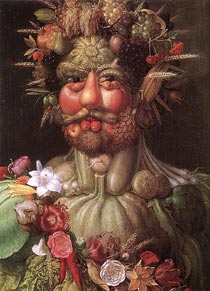
		
		<div style="float:right; padding:15px 5px 5px 5px"><img src="http://culture-making.com/media/433px-Arcimboldovertemnus_210.jpg" alt="image"></div><p>What issues might we be thinking about in trying to decide whether to classify cooking as one of the arts? Here are some.</p>
<p>1) Is the person who says of the Chateau Petrus they have just tasted that it is a work of art to be taken literally? </p>
<p>2) Is the experience we have of a Beethoven String Quartet sufficiently different from that we have when eating a great meal so that we should distinguish them as different kinds of experience?</p>
<p>3) Does it make sense to say of someone that they have been moved by a meal?</p>
<p>4) Is it significant for classifying something as an art form that a meal is consumed in the process of appreciation?</p>
<p>5) When I say of Grant Achatz that he is an artist in the kitchen how does this differ from saying he is a genius at the stove?</p>
<p>6) Why do we distinguish between the architect who designed Notre Dame and those who built it by designating the latter as craftsmen and the former as an artist? Is there a class bias exhibited by this distinction?</p>
<p>7) A piece of music can express sadness. A pate cannot. So?
</p><hr />
<div class="author" style="font-size: -1">from "<a href="http://www.3quarksdaily.com/3quarksdaily/2009/03/penne-for-your-thought.html">Penne for Your Thought</a>," by Gerald Dworkin, <a href="http://www.3quarksdaily.com/3quarksdaily/2009/03/penne-for-your-thought.html">3quarksdaily</a>, 9 March 2009 :: <a href="http://en.wikipedia.org/wiki/Giuseppe_Arcimboldo">Vertemnus / Rudolf II</a>, by Giuseppe Arcimboldo (1527–1593), Wikipedia :: first posted here 18 March 2009</div>		


      ]]></content>
    </entry>    <entry>
      <title>Strawberries and reindeer</title>
      <link rel="alternate" type="text/html" href="https://culture-making.com/post/strawberries_and_reindeer" />
      <id>tag:culture-makers.com,2025:author/1.870</id>
      <published>2025-01-02T22:53:00Z</published>
      <updated>2025-01-03T22:54:05Z</updated>
      <author>
            <name>Andy Crouch</name>
            <email>andy@culture-making.com</email>
            
      </author>

      <content type="html"><![CDATA[


					<b><p>Nate</p>: </b><em>?From an interstitial essay in a wonderful book of portraits and reportage examining what foods "typical" families from around the world eat in the course of a week.?</em><br />
		
		<p>Cooking is universal among our species. Cooking is even more uniquely characteristic of our species than language. Animals do at least bark, roar, chirp, do at least signal by sound; only we bake, boil, roast and fry&#8230;.</p>
<p>Few advances comparable in importance to cooking have happened since [its development]. The most important have been more quantitative than qualitative. We began not simply to harvest but to adopt certain palatable plants and animals as aids and conspirators. By 3,000 to 4,000 years ago, we had domesticated all those that have been central to our diets ever sense—barley, wheat, rice, maize, potatoes, sheep, goats, cattle, horses, and so on&#8230;. We have domesticated nothing more significant than strawberries and reindeer since.</p><hr />
<div class="author" style="font-size: -1">from "<a href="about:blank">Baked, Boiled, Roasted and Fried</a>," by Alfred W. Crosby, in Peter Menzel and Faith D'Alusio's <a href="http://www.amazon.com/Hungry-Planet-What-World-Eats/dp/1580086810"><i>Hungry Planet: What the World Eats</i></a>, 2005 :: first posted here 29 September 2008</div>		


      ]]></content>
    </entry>    <entry>
      <title>Are carrots protestant?</title>
      <link rel="alternate" type="text/html" href="https://culture-making.com/post/are_carrots_protestant" />
      <id>tag:culture-makers.com,2025:author/1.1772</id>
      <published>2025-01-02T22:53:00Z</published>
      <updated>2025-01-03T22:54:05Z</updated>
      <author>
            <name>Andy Crouch</name>
            <email>andy@culture-making.com</email>
            
      </author>

      <content type="html"><![CDATA[


					<b>Nate: </b><em>?It's fun to be reminded how many of our 'natural' foods are in fact the result of a long collaboration between cultivator and cultivated, guided by the possibilities and limits of agriculture and by the choices and preferances of particular people in particular settings. According to the <a href="http://www.carrotmuseum.co.uk/">World Carrot Museum</a>—let me say that again: the <a href="http://www.carrotmuseum.co.uk/">World Carrot Museum</a>—the long orange carrot of supermarket and snowman-nose and Bugs Bunney fame was popularized by Dutch breeders in the 17th century, perhaps as a tribute to <a href="http://en.wikipedia.org/wiki/William_the_Silent">William of Orange</a>, the the Dutch independance leader who became a Calvinist and helped get the 80 years war started. His grandson <a href="http://en.wikipedia.org/wiki/William_III_of_England">William III</a> ruled the Netherlands and, later on, the British Isles, where he was responsible for the introduction of orange as the favored color of Irish protestants.?</em><br />
		
		<a href="http://www.nextnature.net/?p=3829"><img src="http://culture-making.com/media/carrots_of_many_colors_530.jpg" alt="photo" /></a><hr />
<div class="author" style="font-size: -1">from "<a href="http://www.nextnature.net/?p=3829">Why are carrots orange? It is political</a>," by Koert van Mensvoort, <a href="http://www.nextnature.net/">Next Nature</a>, 16 August 2009 :: image via <a href="http://upload.wikimedia.org/wikipedia/commons/3/32/Carrots_of_many_colors.jpg">Wikipedia</a>, unattributed :: first posted here 4 January 2010</div>		


      ]]></content>
    </entry>    <entry>
      <title>Some assembly revered</title>
      <link rel="alternate" type="text/html" href="https://culture-making.com/post/some_assembly_revered" />
      <id>tag:culture-makers.com,2025:author/1.1616</id>
      <published>2025-01-02T22:53:00Z</published>
      <updated>2025-01-03T22:54:05Z</updated>
      <author>
            <name>Andy Crouch</name>
            <email>andy@culture-making.com</email>
            
      </author>

      <content type="html"><![CDATA[


					<b>Nate: </b><em>?Does investing our own (fruitful) labor into a cultural artifact's creation cause us to overvalue said artifact, as these business-school-types argue? Or is it rather that the investment of a fresh egg or a few turns of an allen wrench counteracts a tendency to undervalue—and underappreciate—the labor of others??</em><br />
		
		<p>When instant cake mixes were introduced, in the
1950s, housewives were initially resistant: The mixes were too easy, suggesting that their labor was undervalued. When manufacturers changed the recipe to require the addition of an egg, adoption
rose dramatically. Ironically, increasing the labor involved – making the task more arduous – led to greater liking&#8230;.</p><p>When people construct products themselves, from bookshelves to Build-a-Bears, they come to overvalue their (often poorly made) creations. We call this phenomenon the IKEA effect, in honor of the wildly successful Swedish manufacturer whose products typically arrive with some assembly required.</p><p>In one of our studies we asked people to fold origami and then to bid on their own creations along with other people’s. They were consistently willing to pay more for their own origami. In fact, they were so enamored of their amateurish creations that they valued them as highly as origami made by experts.</p><p>We also investigated the limits of the IKEA
effect, showing that labor leads to higher
valuation only when the labor is fruitful&#8230;</p><hr />
<div class="author" style="font-size: -1">from "<a href="http://hbr.harvardbusiness.org/web/2009/hbr-list/ikea-effect-when-labor-leads-to-love">The IKEA Effect</a>," by Michael I. Norton, <a href="http://hbr.harvardbusiness.org/web/2009/hbr-list/ikea-effect-when-labor-leads-to-love"><i>Harvard Business Review</i></a>, February 2009 :: via <a href="http://ayjay.tumblr.com/post/181115340/when-instant-cake-mixes-were-introduced-in-the">more than 95 theses</a> :: first posted here 9 September 2009</div>		


      ]]></content>
    </entry>    <entry>
      <title>The daily grind</title>
      <link rel="alternate" type="text/html" href="https://culture-making.com/post/the_daily_grind" />
      <id>tag:culture-makers.com,2025:author/1.1930</id>
      <published>2025-01-02T22:53:00Z</published>
      <updated>2025-01-03T22:54:05Z</updated>
      <author>
            <name>Andy Crouch</name>
            <email>andy@culture-making.com</email>
            
      </author>

      <content type="html"><![CDATA[


					<b>Nate: </b><em>?To make tortillas the traditional way, first you have to cook the maize with something alkaline (cement, for instance), and then grind the wet grains by hand, kneeling on the floor with your metate. It takes about an hour to grind enough to feed one person for one day. Until fifty years ago, there was no effective widespread way to automate this process: every Mexican household would have one woman in the back room, grinding wet corn for five hours a day. Since then, things have changed—bringing great benefits, widespread social change, and some losses too.?</em><br />
		
		<p>Of course, there are trade-offs. <a href="http://en.wikipedia.org/wiki/Grupo_Bimbo">Bimbo</a> is not as good as a <i><a href="http://en.wikipedia.org/wiki/Bolillo">bolillo</a></i>. A machine-made tortilla is not anything like a homemade tortilla – it’s not even in the same universe.</p><p>Mexican women that I have talked to are very explicit about this trade-off. They know it doesn’t taste as good; they don’t care. Because if they want to have time, if they want to work, if they want to send their kids to school, then taste is less important than having that bit of extra money, and moving into the middle class. They have very self-consciously made this decision. In the last ten years, the number of women working in Mexico has gone up from about thirty-three percent to nearly fifty percent. One reason for that—it’s not the only reason, but it is a very important reason—is that we’ve had a revolution in the processing of maize for tortillas.</p><hr />
<div class="author" style="font-size: -1">from "<a href="http://www.ediblegeography.com/fueling-mexico-city-a-grain-revolution/">Fueling Mexico City: A Grain Revolution</a>," by <a href="http://www.rachellaudan.com/2010/06/fueling-mexico-city-a-grain-revolution.html">Rachel Laudan</a>, <a href="http://www.ediblegeography.com/fueling-mexico-city-a-grain-revolution/">edible geography</a>, 14 June 2010</div>		


      ]]></content>
    </entry>    <entry>
      <title>Due finocchi, by Trevor Haddrell</title>
      <link rel="alternate" type="text/html" href="https://culture-making.com/post/due_finocchi_by_trevor_haddrell" />
      <id>tag:culture-makers.com,2025:author/1.1914</id>
      <published>2025-01-02T22:53:00Z</published>
      <updated>2025-01-03T22:54:05Z</updated>
      <author>
            <name>Andy Crouch</name>
            <email>andy@culture-making.com</email>
            
      </author>

      <content type="html"><![CDATA[


					<b>Nate: </b><em>?Now that's some handsome fennel—the majestic composition reminds me of a Spanish galleon at full sail. I love this Bristol, UK artist's botanical and culinary wood engravings. You can buy this one (by printing out an order form and mailing it in!) from the storied Society of Wood Engravers, or seek out a copy of Haddrell's book, <a href="http://www.amazon.com/Asparagus-Other-Friends-Engravings-Vegetables/dp/1904537375/cmcom-20">Asparagus and Other Friends</a>.?</em><br />
		
		<a href="http://www.woodengravers.co.uk/gallery03.html"><img src="http://culture-making.com/media/duefinocchi.jpg" alt="image" /></a><hr />
<div class="author" style="font-size: -1">"<a href="http://www.woodengravers.co.uk/gallery03.html">Due Finocchi</a>," 17 x 22 cm, by Trevor Haddrell, <a href="http://www.woodengravers.co.uk/gallery03.html">The Society of Wood Engravers</a> :: via <a href="http://thingsmag.wordpress.com/2010/05/21/random-linkage/">things magazine</a></div>		


      ]]></content>
    </entry>    <entry>
      <title>A great old time classic American melon</title>
      <link rel="alternate" type="text/html" href="https://culture-making.com/post/a_great_old_time_classic_american_melon" />
      <id>tag:culture-makers.com,2025:author/1.1899</id>
      <published>2025-01-02T22:53:00Z</published>
      <updated>2025-01-03T22:54:05Z</updated>
      <author>
            <name>Andy Crouch</name>
            <email>andy@culture-making.com</email>
            
      </author>

      <content type="html"><![CDATA[


			<p align="center"><object width='400' height='300'><param name='movie' value='http://www.cbs.com/e/gNXE8ag3M5n46W6Flniwqcy4jn7Flz3E/chow/1/'></param><param name='allowFullScreen' value='true'></param><param name='allowScriptAccess' value='always'></param><param name='FlashVars' value='config=http://search.chow.com/config/canPlayer'></param><embed width='400' height='300' src='http://www.cbs.com/e/gNXE8ag3M5n46W6Flniwqcy4jn7Flz3E/chow/1/'  allowfullscreen='true' allowScriptAccess='always' type='application/x-shockwave-flash' FlashVars='config=http://search.chow.com/config/canPlayer'></embed></object></p><br />
<b>Nate: </b><em>?An interview with Jeremiah "Jere" Gettle, founder of <a href="http://rareseeds.com/">Baker County Heirloom Seeds</a>, on the joys of seed-saving, -sharing, and of course -cultivating. Filmed in the company's "seed bank" storefront, the converted historic <a href="http://maps.google.com/maps?oe=UTF-8&q=199+Petaluma+Blvd.+NorthPetaluma,+CA+94952&ie=UTF8&hq=&hnear=199+Petaluma+Blvd+N,+Petaluma,+Sonoma,+California+94952&gl=us&ei=7bnhS5XeNITcNsbnrYsD&ved=0CAwQ8gEwAA&ll=38.235519,-122.641118&spn=0.001321,0.002073&t=h&z=19&layer=c&cbll=38.235682,-122.641363&panoid=inGf5xf4vxEPl_4yHXI4vQ&cbp=12,159.4,,0,-3.62">Sonoma County National Bank Building</a>.?</em><br />
<hr /><span style="font-size: -1">"<a href="http://www.chow.com/videos/show/obsessives/12150/obsessives-seeds#!/show/obsessives/12150/obsessives-seeds">Obsessives: Seeds</a>," by Leslie Jonath, Eric Slatkin, Blake Smith, and Roxanne Webber, <a href="http://www.chow.com/videos/show/obsessives/12150/obsessives-seeds#!/show/obsessives/12150/obsessives-seeds"> CHOW</a>, 29 April 2010 :: via <a href="http://coudal.com/archives/2010/05/chow_obsessives.php?utm_source=feedburner&utm_medium=feed&utm_campaign=Feed%3A+CoudalFreshSignals+%28Coudal%3A+Fresh+Signals%29&utm_content=Google+Reader">Coudal Partners</a></span>


      ]]></content>
    </entry>    <entry>
      <title>One chili a week</title>
      <link rel="alternate" type="text/html" href="https://culture-making.com/post/one_chili_a_week" />
      <id>tag:culture-makers.com,2025:author/1.1867</id>
      <published>2025-01-02T22:53:00Z</published>
      <updated>2025-01-03T22:54:05Z</updated>
      <author>
            <name>Andy Crouch</name>
            <email>andy@culture-making.com</email>
            
      </author>

      <content type="html"><![CDATA[


					<b>Andy: </b><em>?Maybe nothing has surprised and pleased me more about the response to <i>Culture Making</i> than the enthusiasm for my chili recipe. But Jason Panella has taken it to another level—inspired by <i>Culture Making,</i> he is making a year's worth of chili, and learning about the United States, and himself, along the way. I love it.?</em><br />
		
		<p>My year-long exploration of the United States is—so far, at least—surprisingly cost-efficient. My trip from the state of Washington to Pennsylvania, for instance, only cost around $9. If I keep this up, I&#8217;ll be able to smell the smells and taste the tastes from the Atlantic to the Pacific—non-contiguous states and the District of Columbia included—for a little over $100. And it&#8217;ll keep me fed in the process. So far, this journey has taught me a lot about myself, about discipline, about improvisation under pressure, and an awful, awful lot about chili.</p><p>Chili. <i>Chili con carne</i>, or &#8220;peppers with meat&#8221; in Spanish. Simply meat and chili peppers, if you&#8217;re a purist (plus a lot of other ingredients, if you&#8217;re not). OK, so I&#8217;m not actually traveling from state to state, but instead I&#8217;ve been using Jane and Michael Stern&#8217;s <a href="http://www.amazon.com/gp/product/0767902637?ie=UTF8&amp;tag=cmcom-20&amp;linkCode=as2&amp;camp=1789&amp;creative=390957&amp;creativeASIN=0767902637"><i>Chili Nation</i></a> (Random House, 1999) cookbook as a tour guide. The Sterns made stops in each state and collected recipes that they felt captured some of the local flavour—coffee-accented chili from the state of Washington, chili with seafood in place of beef from Maryland, a flavourful dish popularized by some of the diners on Mississippi&#8217;s Route 61, and so on.</p><p>So, in lieu of spending a year traveling, I thought I&#8217;d let my tastebuds and stomach take a trip instead. Fifty-one chili recipes in 52 weeks. One chili a week, with one week off (which I&#8217;ll probably cash in on my honeymoon, but my fiancée likes chili too, so maybe not!)</p><hr />
<div class="author" style="font-size: -1">from "<a href="http://www.cardus.ca/comment/article/1842/">The U.S., one bowl of chili at a time</a>," by Jason Panella, <a href="http://www.cardus.ca/comment/">Comment</a>, 9 April 2010</div>		


      ]]></content>
    </entry>    <entry>
      <title>Food culture and the Last Supper</title>
      <link rel="alternate" type="text/html" href="https://culture-making.com/post/food_culture_and_the_last_supper" />
      <id>tag:culture-makers.com,2025:author/1.1848</id>
      <published>2025-01-02T22:53:00Z</published>
      <updated>2025-01-03T22:54:05Z</updated>
      <author>
            <name>Andy Crouch</name>
            <email>andy@culture-making.com</email>
            
      </author>

      <content type="html"><![CDATA[


					<b>Nate: </b><em>?I suppose this finding would fall into the "interesting but unsurprising" category, but I'm nevertheless overjoyed that historians of art, food, and culture do this kind of stuff.?</em><br />
		
		<p>Wansink teamed up with his brother Craig Wansink, a religious studies professor at Virginia Wesleyan College, to look at how portion sizes have changed over time by examining the food depicted in 52 of the most famous paintings of the scene from the Last Supper.</p><p>&#8220;As the most famously depicted dinner of all time, the Last Supper is ideally suited for review,&#8221; Craig Wansink said.</p><p>From the 52 paintings, which date between 1000 and 2000 A.D., the sizes of loaves of bread, main dishes and plates were calculated with the aid of a computer program that could scan the items and rotate them in a way that allowed them to be measured. To account for different proportions in paintings, the sizes of the food were compared to the sizes of the human heads in the paintings.</p><p>The researchers&#8217; analysis showed that portion sizes of main courses (usually eel, lamb and pork) depicted in the paintings grew by 69 percent over time, while plate size grew by 66 percent and bread size grew by 23 percent.</p><hr />
<div class="author" style="font-size: -1">from "<a href="http://www.livescience.com/culture/large-last-supper-100323.html">Portion Sizes in 'Last Supper' Paintings Grew Over Time</a>," by Andrea Thompson, <a href="http://www.livescience.com/culture/large-last-supper-100323.html">LiveScience</a>, 23 March 2010 :: via <a href="http://kottke.org/10/03/supersizing-the-last-supper">kottke.org</a></div>		


      ]]></content>
    </entry>    <entry>
      <title>Flinty and grassy with finesse and subtlety</title>
      <link rel="alternate" type="text/html" href="https://culture-making.com/post/flinty_and_grassy_with_finesse_and_subtlety" />
      <id>tag:culture-makers.com,2025:author/1.1842</id>
      <published>2025-01-02T22:53:00Z</published>
      <updated>2025-01-03T22:54:05Z</updated>
      <author>
            <name>Andy Crouch</name>
            <email>andy@culture-making.com</email>
            
      </author>

      <content type="html"><![CDATA[


					<b>Nate: </b><em>?From an essay on the culture and history of dirt-eating, often undertaken by pregnant women (presumably craving specific needed minerals), but until recently surprisingly widespread. "In the 1970s, fifty percent of Black women admitted to eating clay, about four times the frequency among white women ..." I like the idea outlined below, of sniffing the soil and then tasting produce grown in it.?</em><br />
		
		<p>People living in San Francisco can find a soil tasting in a nearby art gallery; the rest of us can e-participate through a website (<a href="http://tasteofplace.info/">tasteofplace.info</a>) run by performance artist and &#8220;agricultural activist&#8221; Laura Parker. Parker strives to answer the question &#8220;how does soil touch our lives and affect our food; and why does it matter?&#8221; To stimulate public dialogue, Parker fills wine goblets with various soils and adds a few teaspoons of water to release the aromas and flavors. The soils aren&#8217;t ingested, but participants place their noses deep into the wine bowls, inhaling the newly released molecules to the backs of their tongues, where taste receptors lie. The website even provides &#8220;Tasting Notes,&#8221; such as the soil of &#8220;Apple Farm-Indian Camp Ground, &#8216;Arrowhead Reserve,&#8217;&#8221; which has a &#8220;texture like ground espresso between your fingertips with a rich, chocolate color. The nose is both flinty and grassy with finesse and subtlety.&#8221; After the soil tasting, participants dine on food grown in the various soils and identify the qualities of the dirt in the food to strengthen the connection between what we eat and where it&#8217;s grown.</p><hr />
<div class="author" style="font-size: -1">from "<a href="http://www.oxfordamerican.org/articles/2010/mar/09/wide-world-eating-dirt/?utm_source=feedburner&utm_medium=feed&utm_campaign=Feed:+OxfordAmericanArticles+(Oxford+American+Articles)&utm_content=Google+Reader">Beth Ann Fennelly Digs into Geophagy</a>," <a href="http://www.oxfordamerican.org/articles/2010/mar/09/wide-world-eating-dirt/?utm_source=feedburner&utm_medium=feed&utm_campaign=Feed:+OxfordAmericanArticles+(Oxford+American+Articles)&utm_content=Google+Reader"><i>Oxford American</i></a>, 9 March 2010</div>		


      ]]></content>
    </entry>    <entry>
      <title>Putting the bourgeois in Bobo for 39 years</title>
      <link rel="alternate" type="text/html" href="https://culture-making.com/post/putting_the_bourgeois_in_bobo_for_39_years" />
      <id>tag:culture-makers.com,2025:author/1.1834</id>
      <published>2025-01-02T22:53:00Z</published>
      <updated>2025-01-03T22:54:05Z</updated>
      <author>
            <name>Andy Crouch</name>
            <email>andy@culture-making.com</email>
            
      </author>

      <content type="html"><![CDATA[


					<b>Andy: </b><em>?Piquantly contrarian essay on Starbucks' real genius: its appeal to the unreconstructed American consumer.?</em><br />
		
		<p>For Schultz, this mainstream customer base was both a boon and a
curse. In <i>Pour Your Heart Into It</i>, his 1997 account of
Starbucks’ rise to global behemoth, he reveals a preoccupation with
authenticity that echoed Kurt Cobain’s. In 1989, he initially
balked at providing non-fat milk for customers—it wasn’t how the
Italians did it. When word trickled up to him that rival stores in
Santa Monica were doing big business in the summer months selling
blended iced coffee drinks, he initially dismissed the idea as
something that “sounded more like a fast-food shake than something
a true coffee lover would enjoy.”</p><p>Eventually, Schultz relented. And really, what greater punk-rock
middle finger is there to purist prescriptions about what
constitutes a true coffee drink than a blended ice beverage
flavored with Pumpkin Spice powder? . . . </p><p>In reality, the chain’s customers have played a substantial role
in determining the Starbucks experience. They asked for non-fat
milk, and they got it. They asked for Frappuccino, and they got it.
What they haven’t been so interested in is Starbucks’ efforts to
carry on the European coffeehouse tradition of creative interaction
and spirited public discourse.</p><p>Over the years, Starbucks has tried various ways to foster an
intellectual environment. In 1996 it tried selling a paper version
of <i>Slate</i> and failed. In 1999 it introduced its own
magazine, <i>Joe</i>. “Life is interesting. Discuss,” its tagline
encouraged, but whatever discussions <i>Joe</i> prompted could
sustain only three issues. In 2000 Starbucks opened Circadia, an
upscale venue in San Francisco that <i>Fortune</i> described as
an attempt to “resurrect the feel of the 1960s coffee shops of
Greenwich Village.” The poetry readings didn’t work because
customers weren’t sure if they were allowed to chat during the
proceedings. The majority of Starbucks patrons, it seems, are happy
to leave the European coffeehouse tradition to other retailers.</p><hr />
<div class="author" style="font-size: -1">from "<a href="http://reason.com/archives/2010/02/09/starbucks-midlife-crisis">Starbucks’ Midlife Crisis - Reason Magazine</a>," by Greg Beato, <a href="http://reason.com/">Reason Magazine</a>, March 2010 :: via <a href="http://aldaily.com">Arts & Letters Daily</a></div>		


      ]]></content>
    </entry>    <entry>
      <title>Do you know where your taco comes from?</title>
      <link rel="alternate" type="text/html" href="https://culture-making.com/post/do_you_know_where_your_taco_comes_from" />
      <id>tag:culture-makers.com,2025:author/1.1821</id>
      <published>2025-01-02T22:53:00Z</published>
      <updated>2025-01-03T22:54:05Z</updated>
      <author>
            <name>Andy Crouch</name>
            <email>andy@culture-making.com</email>
            
      </author>

      <content type="html"><![CDATA[


					<b>Nate: </b><em>?An attempt to map the journey taken by all the ingredients of a taco sold at a local taco truck in San Francisco. You can view a larger, barely legible version of this fascinating chart <a href="http://rebargroup.org/doxa/wp-content/uploads/2010/02/TacoWorld_large_9-all-red2-1024x640.jpg">here</a>. The orange lines on the map are thickest for edible shipments, thinner/dotted for aluminum and propane. The bar graph at the lower left lists the ingredients and distance travelled; the bar thickness indicates the type of shipment—thickest for trucking, thinner for train travel and ocean voyages. The list of ingredients, from least- to most-travelled is: Salt, Cheese, Tomatoes, Californian Propane, Cilantro, Sour Cream, Onions, Beef, Corn Oil, Lime, Tortillas, Pinto Beans, Chicken, Avocados, Rice, Saudi Arabian Propane, Adobo Seasoning, and Aluminum.?</em><br />
		
		<a href="http://rebargroup.org/doxa/2010/02/tacoshed/"><img src="http://culture-making.com/media/TacoWorld_large_9-all-red2-1024x640.jpg" alt="image" /></a><hr />
<div class="author" style="font-size: -1">from "<a href="http://rebargroup.org/doxa/2010/02/tacoshed/">Tacoshed</a>," by students of the <a href="http://www.cca.edu/">California College of the Arts</a>, with <a href="http://fletcherstudio.blogspot.com/">David Fletcher</a> and <a href="http://rebargroup.org/">Rebar</a>, 2009–2010 :: via <a href="http://bldgblog.blogspot.com/2010/02/where-does-your-taco-come-from.html">BLDG Blog</a></div>		


      ]]></content>
    </entry>    <entry>
      <title>You Are What You Eat, photos by Mark Menjivar</title>
      <link rel="alternate" type="text/html" href="https://culture-making.com/post/you_are_what_you_eat_photos_by_mark_menjivar" />
      <id>tag:culture-makers.com,2025:author/1.1817</id>
      <published>2025-01-02T22:53:00Z</published>
      <updated>2025-01-03T22:54:05Z</updated>
      <author>
            <name>Andy Crouch</name>
            <email>andy@culture-making.com</email>
            
      </author>

      <content type="html"><![CDATA[


					<b>Nate: </b><em>?You can tell a lot about people by the contents of their refrigerators. Photographer Mark Menjivar's series of fridge portraits from across Texas (and a few other states) offers food for thought and contemplation, and spurs in me a cleaning impulse I'd forgotten I had.?</em><br />
		
		<a href="http://www.good.is/post/picture-show-you-are-what-you-eat/?GT1=48001"><img src="http://culture-making.com/media/fridges.jpg" alt="photo" /></a><hr />
<div class="author" style="font-size: -1">Clockwise from upper-left: "Midwife/Middle School Science Teacher"; "Owner of Defunct Amusement Park"; "Bar Tender"; "Graphic Designer/Print Shop Owner", from the series "<a href="http://www.good.is/post/picture-show-you-are-what-you-eat/?GT1=48001">You Are What You Eat</a>," photos by <a href="http://www.markmenjivar.com/">Mark Menjivar</a>, featured in <a href="http://www.good.is/post/picture-show-you-are-what-you-eat/?GT1=48001">GOOD</a>, 13 May 2009 :: via <a href="http://www.ediblegeography.com/the-anti-fridge/">edible geography</a></div>		


      ]]></content>
    </entry>    <entry>
      <title>Arigato goazimasu!!</title>
      <link rel="alternate" type="text/html" href="https://culture-making.com/post/arigato_goazimasu" />
      <id>tag:culture-makers.com,2025:author/1.1811</id>
      <published>2025-01-02T22:53:00Z</published>
      <updated>2025-01-03T22:54:05Z</updated>
      <author>
            <name>Andy Crouch</name>
            <email>andy@culture-making.com</email>
            
      </author>

      <content type="html"><![CDATA[


					<b>Andy: </b><em>?What a fascinating and funny idea: a café where you get what the previous person ordered. No peeking!?</em><br />
		
		<p>Located inside the Urban Design Center Kashiwa-no-ha, the Ogori cafe looks innocuous enough, but holds a surprise in store for its patrons. In a nutshell, you get what the person before you ordered, and the next person gets what you ordered. Thus, if you’re in on the game, you can choose to be either a generous benefactor, and treat those that come after you – or try your luck at being cheap. Either way, it’s an interesting experiment that explores surprise, kindness and encourages interactions. . . .</p><p>[Caleb Stasser explains:] &#8220;As I sat down to enjoy my surprise Appletizer, loving this insane idea and wondering what would happen if you tried it in America, a Japanese woman approached the cafe. Since she could actually speak Japanese, she could read the large sign at the front and, fortunately or unfortunately, got advanced warning of what she was in for. Before making a final decision on what to order, she quietly snuck up to me to try to ask me what I had ordered, knowing that it would be her unwavering refreshment destiny. The staff put a quick stop to her trickery, and I didn’t answer.</p><p>&#8220;Of course, regardless of what she ordered, she got the orange juice I ordered a few minutes earlier. But here’s one of the moments that make this experiment cool: she actually chose orange juice, just like I did. So she got what she wanted. Ogori cafe synchronicity!&#8221;</p><hr />
<div class="author" style="font-size: -1">from "<a href="http://www.psfk.com/2009/10/ogori-cafe-service-with-a-surprise.html">Ogori Cafe: Service With a Surprise</a>," from <a href="http://www.psfk.com/">PSFK</a>, 5 October 2009 :: via Jared Mackey (thanks!)</div>		


      ]]></content>
    </entry>    <entry>
      <title>You need a good chopping scene</title>
      <link rel="alternate" type="text/html" href="https://culture-making.com/post/you_need_a_good_chopping_scene" />
      <id>tag:culture-makers.com,2025:author/1.1796</id>
      <published>2025-01-02T22:53:00Z</published>
      <updated>2025-01-03T22:54:05Z</updated>
      <author>
            <name>Andy Crouch</name>
            <email>andy@culture-making.com</email>
            
      </author>

      <content type="html"><![CDATA[


					<b>Nate: </b><em>?Chopping is also excessively cinematic in that it mimics the very techniques of film production and editing, the precise chopping of continuous reality into 24 images per second, the mini-guillotines used to trim and edit film stock, the terminology of cuts and splices.?</em><br />
		
		<p>One of the delights of watching food-centric films is to see the main characters demonstrate their culinary skills. The breaking of an egg, the flipping of an omelet, the chopping of an onion (or a carrot or a piece of celery) become impressive feats when performed with dexterity and brio. The food writer Michael Pollan has noted that television cooking shows have come to resemble athletic events, showcasing the spectacular, often competitive talents of their chefs. In narrative film, however, the spectacle of cooking is always more than spectacle; it is also a dynamic means of representing character. Chopping, in particular, in being both precise and violent, is an exceptionally cinematic activity, capable of expressing repressed emotions of rage, bitterness, and passion. It is no wonder that most every film in which food plays a role invariably has a chopping scene.</p><hr />
<div class="author" style="font-size: -1">from "<a href="http://www.thesmartset.com/article/article01221001.aspx">Eat Drink Actor Director</a>," by Paula Marantz Cohen, <a href="http://www.thesmartset.com/article/article01221001.aspx">The Smart Set</a>, 22 January 2010 :: via <a href="http://www.aldaily.com/">Arts & Letters Daily</a></div>		


      ]]></content>
    </entry>    <entry>
      <title>What food books say</title>
      <link rel="alternate" type="text/html" href="https://culture-making.com/post/what_food_books_say" />
      <id>tag:culture-makers.com,2025:author/1.1791</id>
      <published>2025-01-02T22:53:00Z</published>
      <updated>2025-01-03T22:54:05Z</updated>
      <author>
            <name>Andy Crouch</name>
            <email>andy@culture-making.com</email>
            
      </author>

      <content type="html"><![CDATA[


					<b>Nate: </b><em>?Our shelves of cookbooks are fascinating not so much as a body of knowledge, but as a body of ignorance: they contain what we don't know (or no longer know) about food, but our ignorance and aspirations take on very specific, trend-sensitive forms, a bit like—come to think of it—a good bundt pan waiting for batter.?</em><br />
		
		<p>“Tell me what you eat: I will tell you what you are,” Brillat-Savarin challenged his readers in 1825, and his wisdom if not his brio was already old hat. Human meals serve those mixtures of raw and cooked that make up anthropological codes. Nearly every prescription or preference blends irrational faith and scientific requirements, as Marvin Harris shows in his fascinating <i>Good to Eat</i>: look long enough at a seemingly arbitrary food rule (cloven hooves, sacred cows) and one can probably discover a self-preserving logic behind it, but look hard enough at an apparently sensible directive (a glass of milk, a handful of supplements) and one will like as not detect a prejudice posing as sense. Omnivorous and hungry, body and spirit, we sit down at a table spread with necessary choice; we cannot eat to live, that is, without in some measure living to eat. As Laurie Colwin once put it, then, cookery books will always “hit you where you live.” What seems distinctive and disquieting now, what seems to have increased in the two centuries since Brillat-Savarin shot a turkey in Hartford or even in the two decades since Colwin roasted a chicken in her New York apartment, is the number of volumes hitting us combined with the force of their impact. A nation with a lot of food books is a nation without much sense of food, as <i>The Economist</i> recently pointed out.</p><hr />
<div class="author" style="font-size: -1">from "<a href="http://hudsonreview.com/new/issues/78/what-we-talk-about-when-we-talk-about-food">What We Talk About When We Talk About Food</a>," by Siobhan Phillips, <a href="http://hudsonreview.com/new/issues/78/what-we-talk-about-when-we-talk-about-food"><i>The Hudson Review</i></a>, Summer 2009 :: via <a href="http://www.thesmartset.com/article/article01221001.aspx">The Smart Set</a></div>		


      ]]></content>
    </entry>    <entry>
      <title>Hot dogs of Latin America</title>
      <link rel="alternate" type="text/html" href="https://culture-making.com/post/hot_dogs_of_latin_america" />
      <id>tag:culture-makers.com,2025:author/1.1787</id>
      <published>2025-01-02T22:53:00Z</published>
      <updated>2025-01-03T22:54:05Z</updated>
      <author>
            <name>Andy Crouch</name>
            <email>andy@culture-making.com</email>
            
      </author>

      <content type="html"><![CDATA[


					<b>Nate: </b><em>?I love how even standardized American-cum-global cuisine can still go off in its own condiment-slathered local direction wherever it lands. This list makes me simultaneously very hungry and just a little bit queasy.?</em><br />
		
		<p><b><a href="/wiki/Guatemala" title="Guatemala">Guatemala</a></b> Generally called &#8220;shucos&#8221;, are cooked in a carbon grill. They&#8217;re served with the classic boiled sausage, guacamole, mustard, mayonnaise,boiled cabbage. If you want you can add ketchup, bacon, pepperoni, salami, Spanish chorizo, longaniza or meat. They cost around $0.50 in all Guatemalan cities. You may order the famous &#8220;mixto&#8221; who brings all the toppings already mentioned, but its price may rise to $2.00 or $3.00.</p>

<p><b><a href="/wiki/Colombia" title="Colombia">Colombia</a></b> In <a href="/wiki/Bogotá" title="Bogotá">Bogotá</a> and practically all the country, the hot dog is eaten with an unusually great amount and variety of condiments and fixings. In a single hot dog, is normal to find mashed <a href="/wiki/Potato_chips" title="Potato chips" class="mw-redirect">potato chips</a>, cheese, strings of <a href="/wiki/Ham" title="Ham">ham</a> or <a href="/wiki/Bacon" title="Bacon">bacon</a>, ketchup, mayo, mustard, pineapple sauce, and chopped onion.</p><hr />
<div class="author" style="font-size: -1">from "<a href="http://en.wikipedia.org/wiki/Hot_dog_variations#Other_locations_in_the_Americas">Hot dog variations</a>," Wikipedia :: via <a href="http://globalvoicesonline.org/2009/02/15/guatemala-the-shuco-hot-dog/">Global Voices Online</a></div>		


      ]]></content>
    </entry>

</feed>